

The best thing about this 26 m² beach house is neither the patio nor the view, but a design solution that frees up space (which you won’t find anywhere else).
The yellow of the lemons and the blue of the sea are the inspiration for this tiny beach house where, thanks to the ingenuity of architect Paola Sola, everything fits, even a never-before-seen trick to optimize space.
A seaside home measuring just 26 m2, dominated by geometry, color, and an incredible design solution that makes the most of the space.
This small seaside home in Posillipo measures just 26 square meters. Yet, as soon as you cross the threshold, you realize that every detail has been designed to be truly lived in. No holiday home compromises, no decorative excesses: just simplicity, poetry, and a tailor-made design that reflects the beauty of slow living.
Here is the story of architect Paola Sola, who transformed a forgotten pied-à-terre into an intimate and bright retreat, where the blue of the sea and the yellow of the lemons become part of the décor.
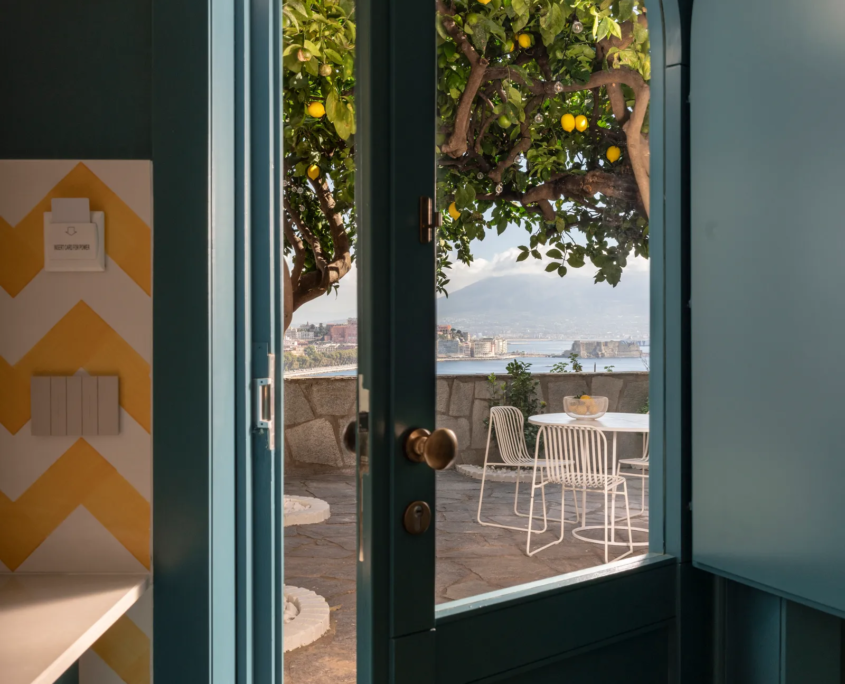
A small blue-paneled door with an arched window frames the view of the Gulf of Naples. One glance is enough to understand that everything here has been designed to interact with the outside world, with light and with the landscape: no barriers, no noise, just the slow rhythm of beauty. Courtesy of Paola Sola. Photo by Dario Borruto.
A former 26 m² pied-à-terre is transformed
We are at the top of the Posillipo ramps, where a small beach house stands hidden among the scents of the Mediterranean. It is not a house like any other: it is a fairytale retreat, carved out of the annex of a large villa, with a courtyard that smells of citrus fruits and a natural pergola that dances between sun and shade.
Yet, until recently, this small building of only 26 square meters was an anonymous closed box, with three blind sides and no identity. A former pied-à-terre, used occasionally, left to the ravages of time. Then something changed: an idea took shape, like a pencil illustration that slowly fills with color.
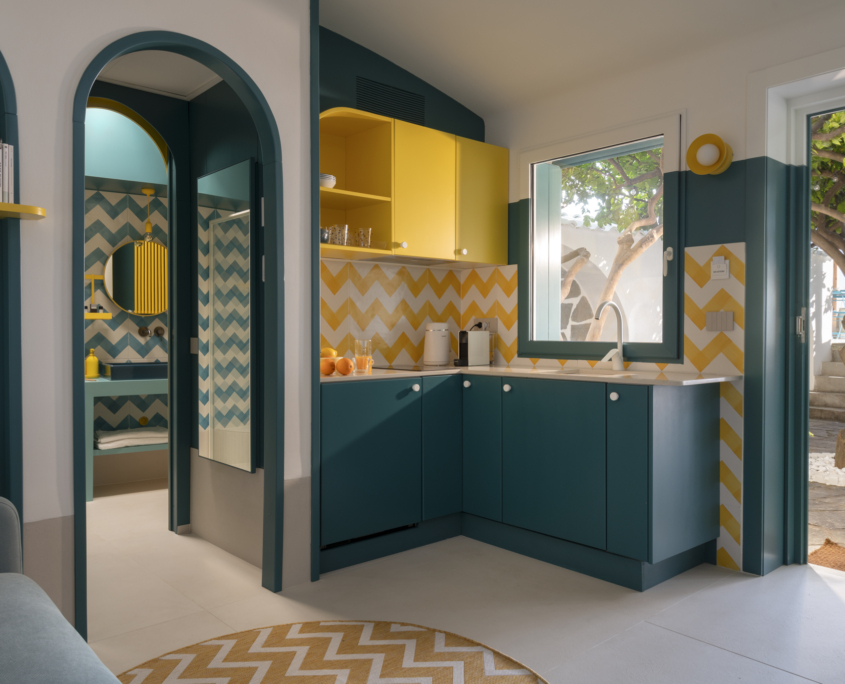
Like the lemon grove that frames the courtyard, yellow appears in measured touches inside, chosen with the same delicacy with which salt is added to a perfect recipe. We find it in the kitchen—visible in the photo—where deep blue alternates with lemon yellow wall units and handmade ceramics by Arcea, arranged to convey the sensation of permanent summer freshness. Courtesy of Paola Sola. Photo by Dario Borruto.
“I wanted this house to reflect its location, but in a discreet, non-didactic way. No Mediterranean stereotypes, just its most intimate essence,” says architect Paola Sola, who designed the project.
Decorative arches: how to incorporate them into your home?
It starts with a question: how do you furnish a small house by the sea? The first challenge was to redesign the spaces, creating a rhythmic sequence that accompanies the transition from the outside world to intimacy. The result is a small arched hallway, which is not only functional but also poetic, with mirrored paneling that conceals the technical rooms and creates an illusion of depth. Every detail is tailored to the house like a bespoke suit.
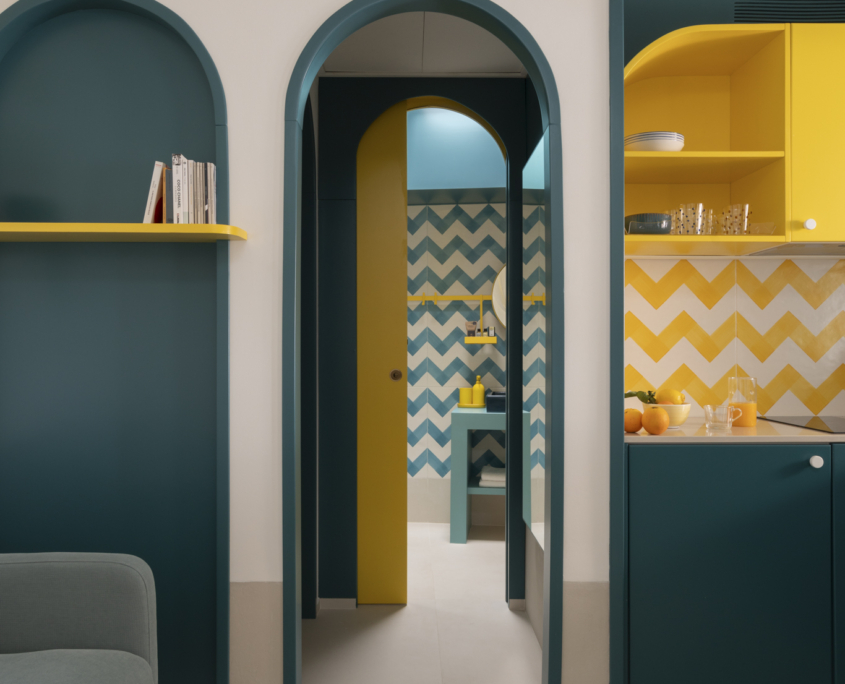
Once past the blue threshold, a small hallway leads from the living area to the bathroom. It is a sequence of arched rooms, designed to soften the space and slow down the pace. Here, a hidden and functional corner takes shape: a small dressing room where luggage can be stored. The mirrored paneling not only conceals the technical compartment but also multiplies the light and expands the perception of space. Courtesy of Paola Sola. Photo by Dario Borruto.
The main room, open and continuous, moves lightly between its functions. The minimalist but fully equipped kitchenette is nestled on either side of the front door, almost disappearing between the lines. The folding table with wooden stools from Zara Home, the sofa that converts into a bed when needed, and the double bed under the skylight: every element is designed to transform, adapt, and surprise.
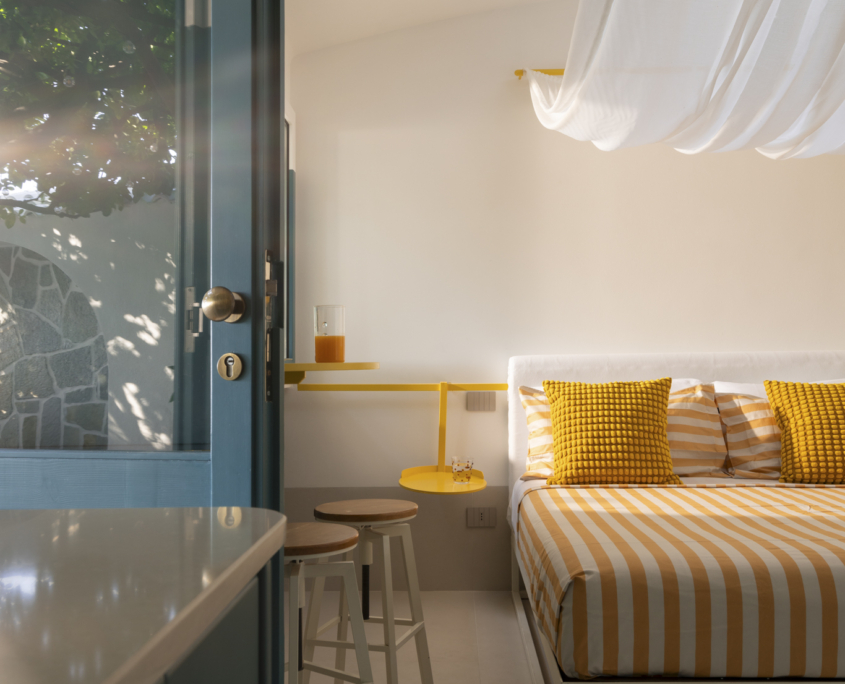
In the bedroom, the custom-designed iron double bed is positioned directly under a skylight that becomes the heart of the room. During the day, it is flooded with natural light, and at night, it offers a glimpse of the stars. The textiles are by Hay, while a Rugvista rug with a textured weave completes the atmosphere. Courtesy of Paola Sola. Photo by Dario Borruto.
The charm of blue in Cycladic architecture
The floor, in a neutral shade, rises up the walls like a continuous baseboard, creating a fluid and harmonious box. The walls are covered with lime stucco, which gives the space a fresh and soft feel. But the real poetic touch is the blue: the same blue as the fishermen’s boats and the Cycladic windows, which paints the fixtures, doors, and doorposts. A distant yet familiar reference.
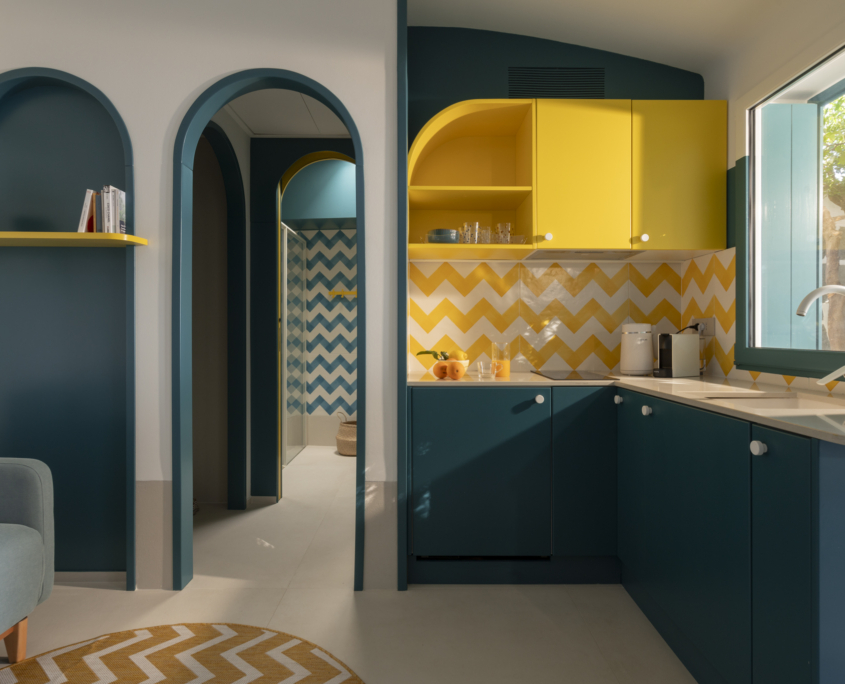
A minimalist yet complete kitchenette. Two primary colors dominate: the yellow of the zigzag kitchen tiles and the blue of the cabinets. Courtesy of Paola Sola. Photo by Dario Borruto.
A lemon-yellow “backbone”
And then, like lemons scattered among the branches, there are yellow details: subtle touches, never intrusive, that convey light. The custom-designed iron storage strip stands out, running like a graphic line around the bed. From here, wooden shelves, towel rails, mirrors, and shelves extend outwards. It is a functional but also narrative element, holding the space together like a lemon-yellow backbone.
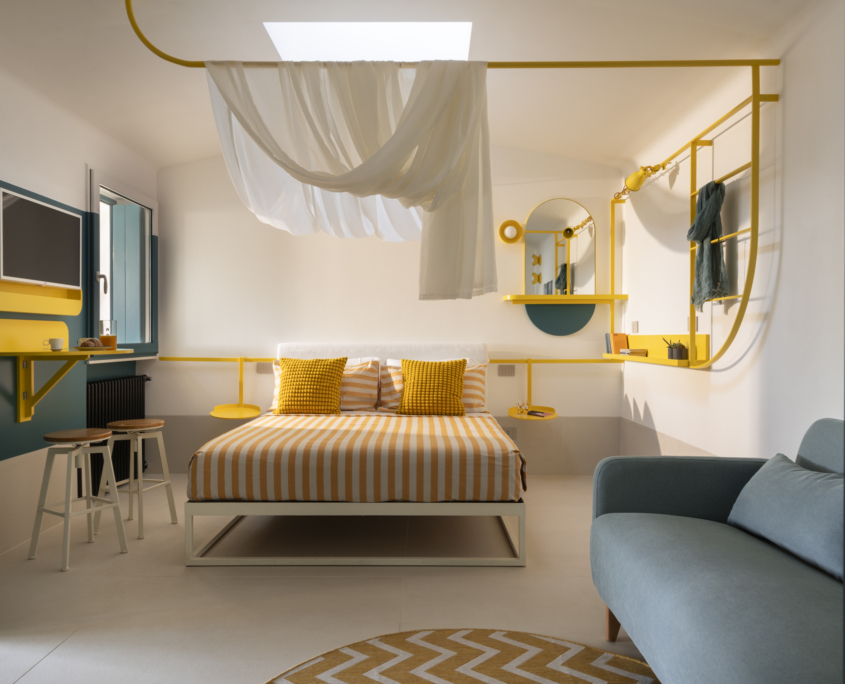
Above the bed, the skylight is not just a functional device: it is a narrative, almost poetic element. It illuminates the space with soft, natural light. Courtesy of Paola Sola. Photo by Dario Borruto.
“I wanted everything to speak the same language, while remaining light, almost invisible,” explains the architect. “Even the bathroom follows this logic: ceramics in custom colors, accessory holders in fire-painted iron, all made by local artisans.”
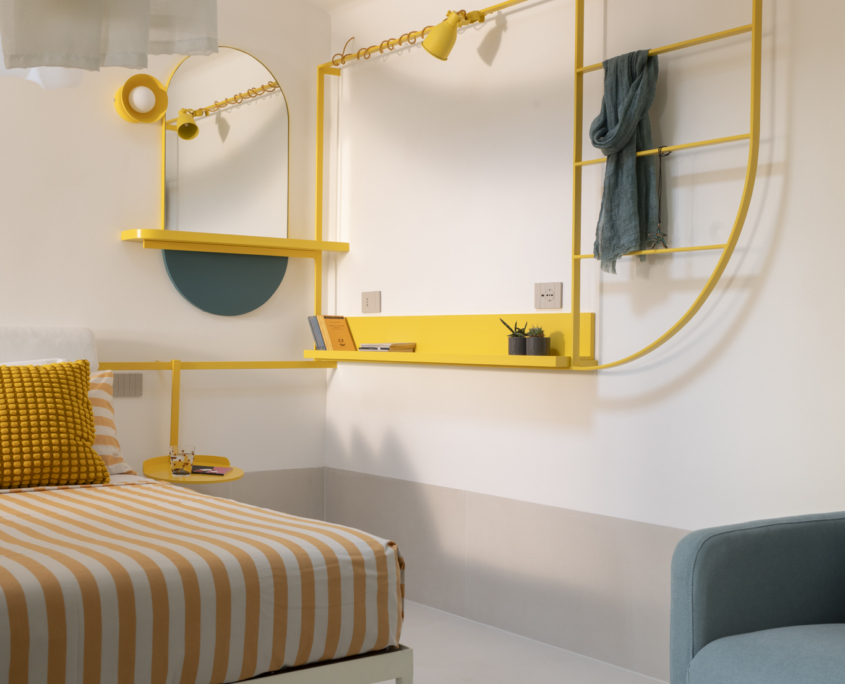
... a bar to which the shelves on either side of the bed are attached, wooden shelves, a mirror for beauty products, and from which the support for the canopy over the bed extends. Courtesy of Paola Sola. Photo by Dario Borruto.
A 50 m² courtyard with a Mediterranean feel
But the house does not end indoors. The experience begins—and perhaps reaches its peak—in the 50-square-meter courtyard, where lemon trees intertwine to form a natural pergola, creating a microcosm suspended in time. Here you can have lunch, read, sunbathe on a deckchair, and forget about the city just a stone’s throw away.
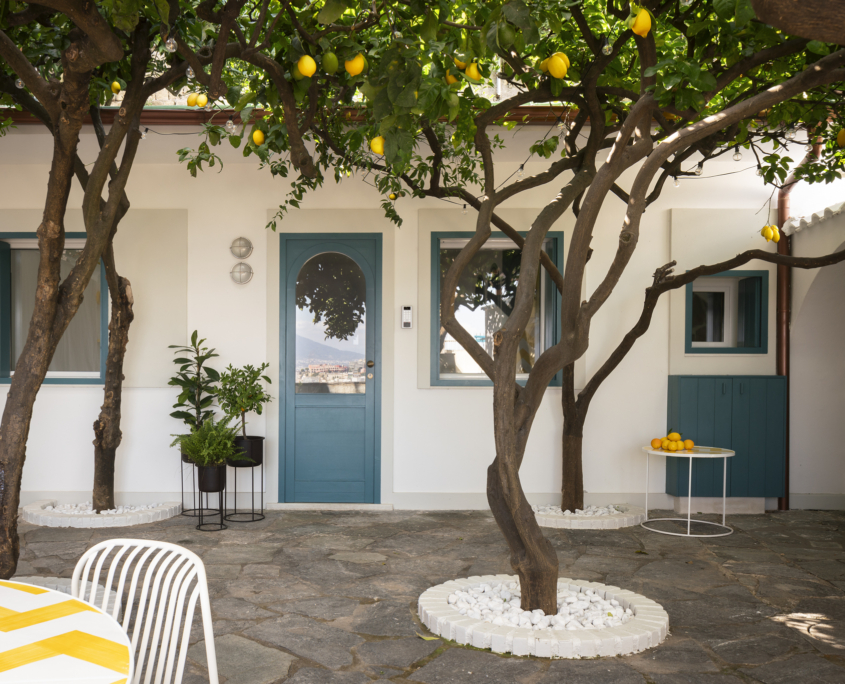
In the courtyard, measuring approximately 50 square meters, there is an intoxicating scent of citrus fruits. Here, lemon trees intertwine to create a natural pergola, a Mediterranean setting bathed in light and shade. Courtesy of Paola Sola. Photo by Dario Borruto.
The outdoor furniture was also custom designed: specially designed iron furnishings embellished with Arcea ceramics from Vietri, the same ones that decorate portions of the walls in the kitchen and bathroom. Each surface tells a little story, a mosaic of color and functionality.
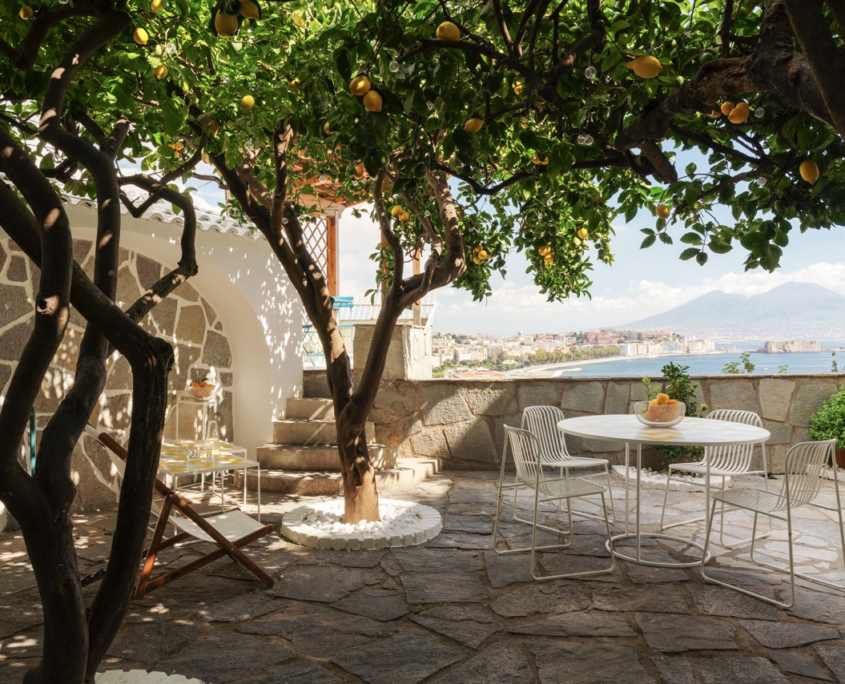
The outdoor furniture was custom designed, such as the specially designed iron table embellished with ceramics from Vietri by Arcea. The chairs are by Emu. Courtesy of Paola Sola. Photo by Dario Borruto.
The house that doesn’t need design icons
This house has no works of art on the walls, nor iconic pieces for design addicts. Yet everything in this small urban oasis is the result of refined thinking. Nothing is left to chance: from the position of the skylight to the texture of the surfaces, every choice speaks of care, tranquility, and lightness.
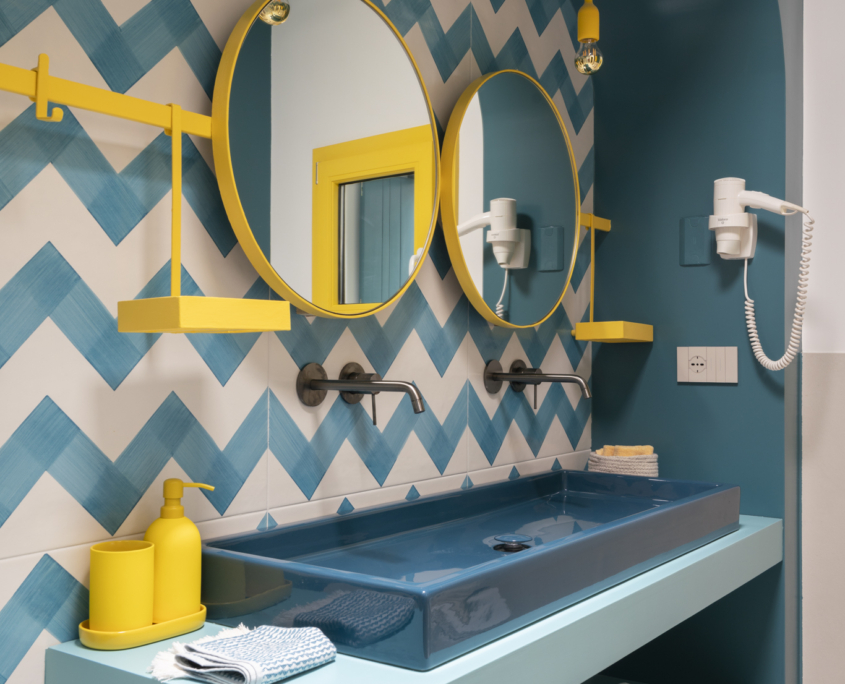
The bathroom, compact but with attention to every detail, features Treemme taps, a Nic Design sink, aquamarine blue Arcea ceramic tiles, and Hay textiles. The mirror is attached to a custom-designed, fire-painted iron rod with matching hooks and storage basket. Creative-Cables wall lamps and Ikea accessories complete the look. Courtesy of Paola Sola. Photo by Dario Borruto.
“I didn’t want to build a set,” concludes the architect, “but a real place that could welcome those who arrive with the desire to breathe in the Mediterranean, even if only for one night. A house to be enjoyed slowly, between the blue of the sea and the yellow of the lemons.”
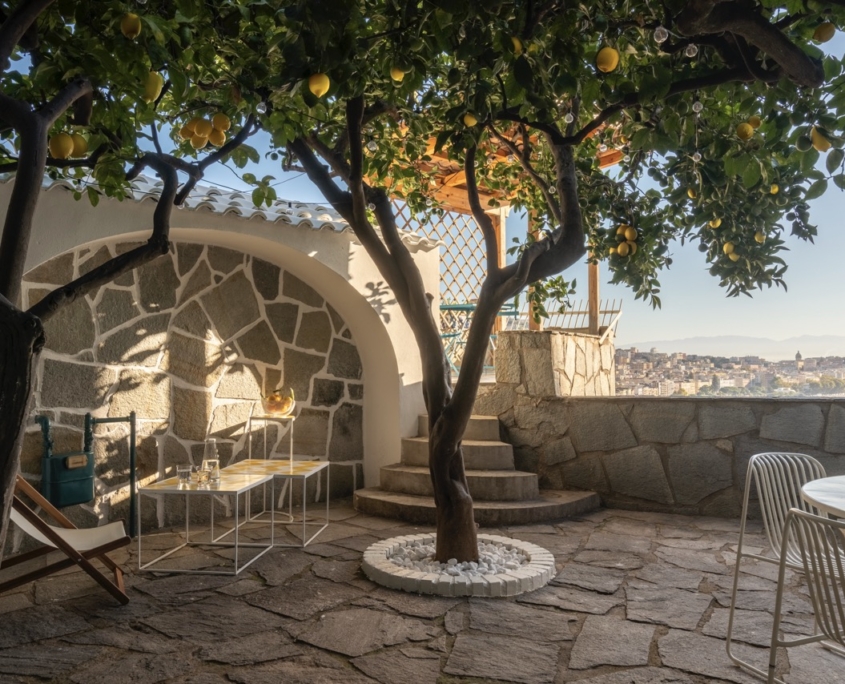
The outdoor pergola with a direct view of the Gulf of Naples. Courtesy of Paola Sola. Photo by Dario Borruto.
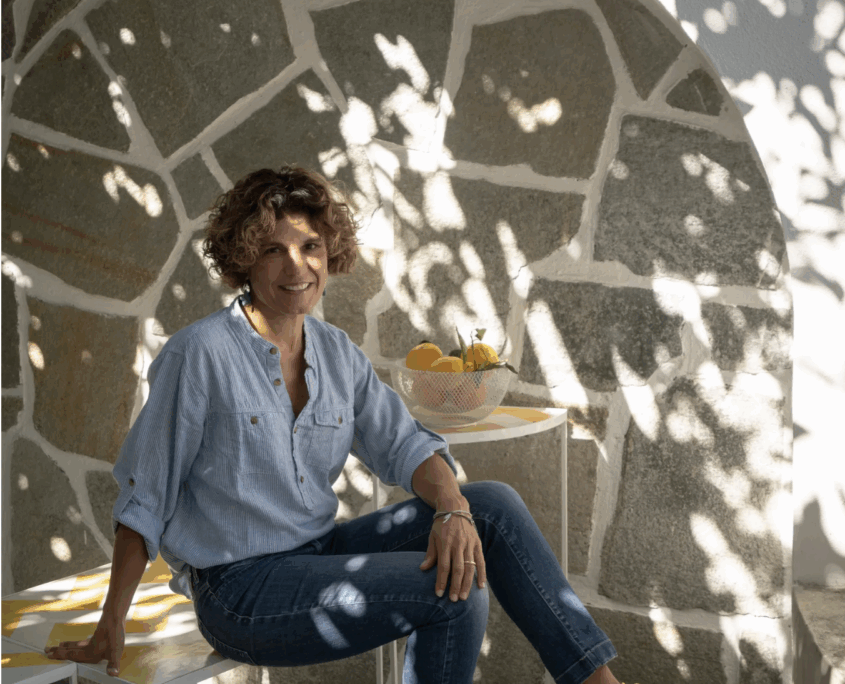
“I wanted this house to reflect its location, but in a discreet, non-didactic way. No Mediterranean stereotypes, just its most intimate essence,” says architect Paola Sola, who designed the project. Courtesy of Paola Sola. Photo by Dario Borruto.
Articolo di Ludovica Stevan Originariamente pubblicato su: Ad-Italia.it